

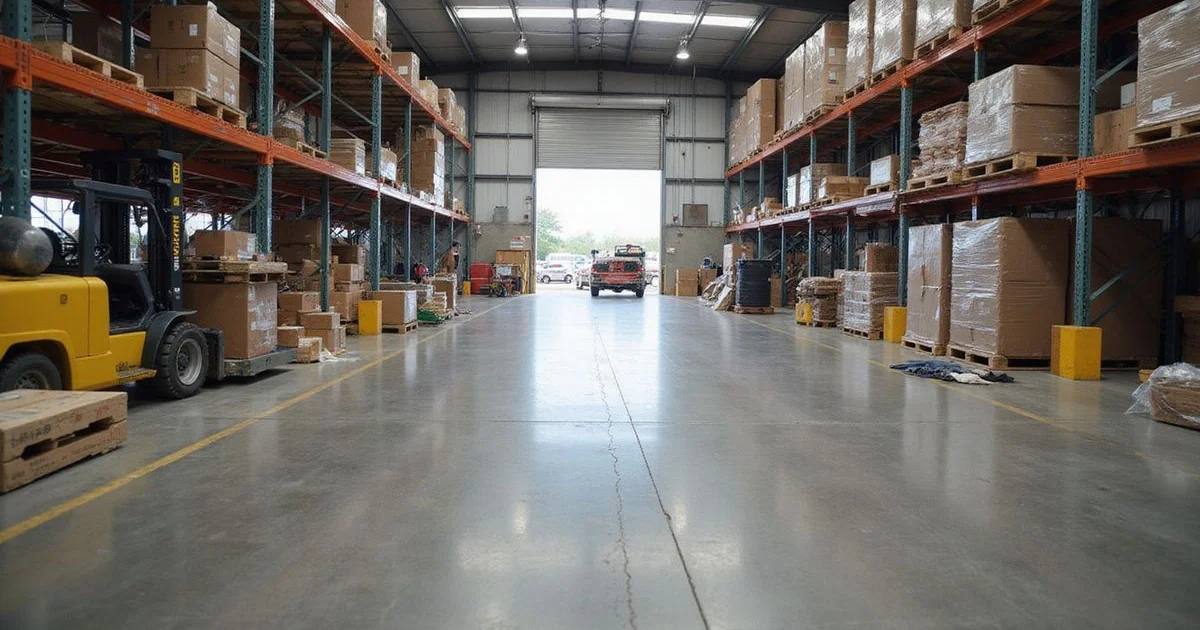
Why distribution floors get polished
People who run warehouses don't pick polished concrete for its looks. They pick it because a hardened, polished slab makes less dust than bare concrete and reflects overhead light, which can mean running fewer lights. It also tends to clean faster with a scrubber machine, and there's no thick coating to peel off and cause a bigger problem.
Warehouse concrete polishing differs from store or home work in almost every way, which is why we treat it as its own topic within our commercial polished concrete work.
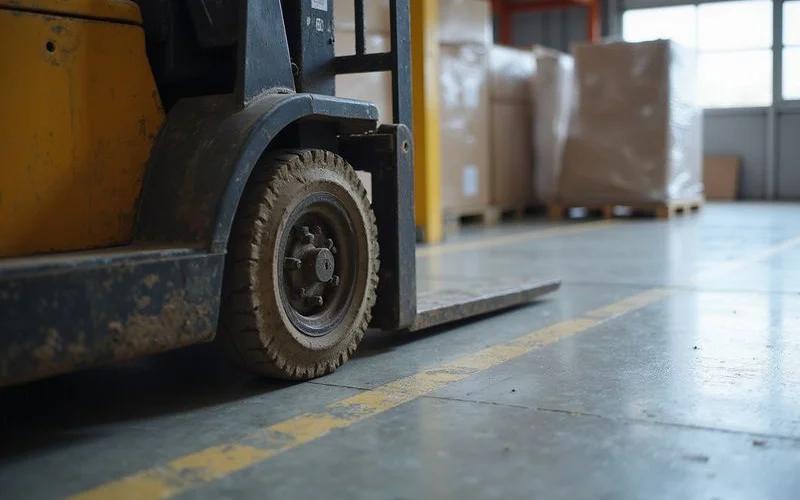
What matters on an industrial floor
Hardness before looks. The silicate hardener, which the trade calls densifier, does real work here. It toughens the surface so it holds up better to wheels, pallets, and loads dragged across it. On a warehouse floor we'd rather see a well hardened floor with some fine stone showing than a glossy cream finish with almost none.
Joint condition. This is where warehouse floors fail. Hard polyurethane forklift wheels pound the bare edges of the control joints, the saw cuts in the slab. Once an edge chips, it gets worse fast, because every wheel after that hits a step instead of a flat surface.
Flatness in pick aisles. Narrow aisle and very narrow aisle warehouses need very flat floors, and the taller the forklift mast, the flatter the floor has to be. Grinding flattens small spots, but it won't fix how level the whole slab is, and we tell you that up front.
Slab history. Old coatings, glue from past racking layouts, oil stains from equipment, and repairs where racks got hit all change how much prep work we need to do.
How joint filling works
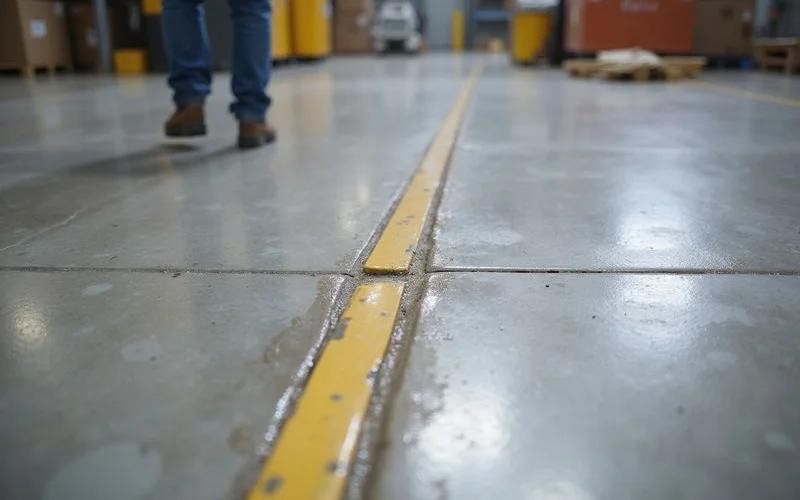
When a floor calls for joint filling, we typically fill the joint all the way down with a firm but slightly flexible polyurea filler, then shave it level. Its job is to back up the joint edges, so a wheel rolls across instead of dropping into a gap and slamming the far edge.
Two things people mix up:
- It's not a sealant. A flexible sealant keeps water out, while a firm filler carries weight, so they're different products for different jobs.
- It doesn't stop the joint from moving. The joint still opens and closes with the seasons, and the filler may pull away a little on one side. That's normal, not a failure.
What goes into a warehouse floor
| Element | Typical warehouse approach |
|---|---|
| How much stone shows | Fine (salt and pepper): tough, forgiving, even |
| Shine level | Medium; high gloss doesn't do much for a warehouse |
| Densifier | Product and step depend on the slab; we go over it at the consultation |
| Joint treatment | Firm polyurea filler where wheels cross joints |
| Repairs | Rack damage, chipped edges, and cracks usually get repaired first |
| Protective treatment | Depends on the site; a protective guard coat helps with oil stains |
| Maintenance | Regular scrubbing plus buffing on a schedule |
Where the savings usually show up
Lighting and cleaning. A polished floor bounces more of the overhead light around, and a scrubber moves faster over a hard, smooth floor than over one that soaks things up. Those savings can add up month after month. The polishing itself is mostly a cost you pay up front.
Working around a warehouse that has to keep running
Very few distribution centers can shut down, so we usually work in zones. We plan around racking layouts and pick paths, and we can often work nights and weekends when both schedules allow. We give you a planned return time for each zone. It's an estimate, and we'll let you know as soon as we can if anything changes it.
Things we plan around:
- Racking that can't be moved, and the strip of floor under it
- Pick locations in use that have to stay open
- Inbound and outbound dock schedules
- Battery charging areas and other fixed equipment
- Fire lanes and marked walkways that have to be painted back
We cover how we plan the work in phases in our commercial project planning guide.
What to check before you commit
A short checklist for a facility manager looking at polished concrete:
Check the joints. Walk the floor and note joints with chipped edges. Those need fixing before or during polishing, and how many there are drives a good part of the cost.
Damage where racks got hit. Rack base plates and forklift hits leave damaged spots that we usually repair during prep. Counting those spots up front helps avoid surprises.
Existing coatings or sealers. Anything put down before, including old line striping, usually has to be ground off.
Oil and fluid contamination. Charging areas, maintenance bays, and spots where equipment parks often have oil soaked in. That oil affects the grinding and how well the hardener gets into the surface.
Line marking plan. Will fire lanes, aisles, and safety markings be painted back, and if so, who does it and how? Settle that before work starts. Striping a polished floor usually takes different prep or products than striping bare concrete.
Can you keep it up? Check that you have or can get a scrubber machine, the right pads, and a pH neutral cleaner. Without a regular scrubbing routine, a polished warehouse floor won't keep looking the way it did on handover day.
What upkeep really looks like
Because a warehouse floor takes far more abuse than a home floor, expect to run a scrubber with the right pad and a pH neutral cleaner. Buff the traffic lanes on a schedule, and put hardener down again now and then in the busiest areas.
Don't expect a floor that never changes, though. Over time, traffic lanes will look different from storage areas. That's wear, not failure, and we can usually fix it. Spot repairs are often easier on a polished floor, and that's where it tends to beat a coating in a warehouse.
Send us your floor size, what kind of traffic it gets, the shape the joints are in, and any limits on when we can work. You'll get our take on the floor and how we'd phase the work, not a price per square foot times a number you gave us over the phone.
Every project starts with an on-site evaluation. Actual scope, pricing, and expected results depend on your specific substrate condition, environment, and project requirements. The website describes our services in general terms. Your signed proposal governs the actual work.