

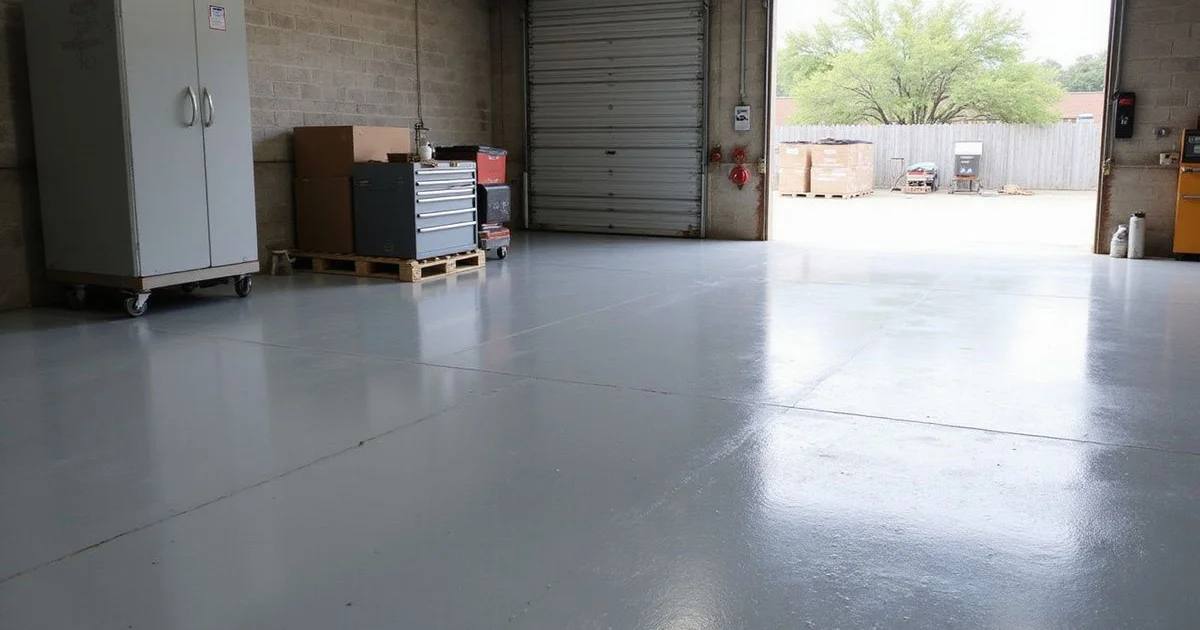
One polishes the slab, the other covers it
That one sentence clears up most of the polished concrete vs epoxy confusion. Mechanical polishing grinds and smooths the concrete you already have, and often hardens it, so the finished surface is the slab itself. Epoxy is a coating stuck onto concrete that's been prepped for it, and what you walk on is a layer sitting on top of the slab.
Everything else follows from that difference: how they look, how they age, how they're repaired, and how they fail.
Side by side
| Consideration | Polished concrete | Epoxy coating |
|---|---|---|
| What you're buying | Your own slab, polished | A coating stuck to the slab |
| Appearance | Natural stone, variation, depth | Uniform color, flake or quartz texture |
| Color options | Dye or stain soaked into the concrete | Almost any color, plus decorative flakes or chips |
| Chemical resistance | Concrete still soaks things up; acids etch | Strong, depends on the product |
| Moisture tolerance | Moisture passes through; usually not a problem | Moisture can lift a coating; testing first often makes sense |
| How it usually fails | Gradual dulling and wear | Peeling, bubbling, coming loose |
| Fixing damage | Polish the spot again; often blends in, but can still show | Patch or recoat; blending is harder |
| Ongoing upkeep | Cleaning plus a buff now and then | Cleaning, and a new coat down the road |
| UV exposure | The concrete isn't affected; some dyes fade in sun | Many epoxies turn yellow in sun without a UV resistant top coat |
| Best spaces for it | Living areas, retail, offices, warehouses | Garages, workshops, areas that get hosed down or see chemicals |
Looks: natural variation or one even color
Polished concrete looks like concrete, just smoother and shinier. The stone in it, color changes between pours, and the slab's history all still show to some degree. People pick it because it's a natural material with depth, and most of them end up enjoying the variation rather than putting up with it.
Epoxy looks manufactured, because it is. A solid color or flake coating gives you a uniform look no slab can match. If you want one even color across a floor with a messy past, a coating gets you there directly.
Prep work: where coatings win or lose
Polishing is its own prep work, since the grinding is the job. Epoxy needs careful prep of its own before anything goes down. Depending on the slab and the system, we may grind or shot blast the concrete to the roughness the product calls for. Then we patch and prime it as needed.
Moisture testing is often the big extra step. Moisture moving up through a slab can push a coating off, and many Central Texas slabs sit on clay that holds water. Whether and how we test depends on the slab and the system, and we'll go over it during the consultation. If an epoxy quote doesn't mention moisture, it's fair to ask why.
How they age differently
A polished floor gets duller, slowly and gently. An epoxy floor usually wears to a point where it needs a new coat, or the coating has to come off.
Cost over time, not just at installation
Upfront prices for the two can come in close, especially once you count the prep a coating needs, but the difference shows up over a decade.
A polished floor usually costs you cleaning and the odd buff, plus polishing it again once in a long while if it gets heavy use. An epoxy floor usually needs a new coat at some point. What that costs depends on whether the old coating can be scuffed up and coated over, or has to come off completely.
Neither one is always cheaper, so the useful thing is knowing how the costs play out over time for the one you pick. Our cost guide covers what drives the price on the polishing side.
Where each one really fits
Choose polishing when: the space is a living area, store, office, showroom, restaurant, or warehouse. You like the natural variation in concrete, the slab is in decent shape for it, and you want very little upkeep over the years.
Choose epoxy when: the space has to stand up to chemicals or needs a continuous surface nothing soaks into, like a garage or workshop with car fluids and hot tires. It's also the pick when the coating has to curve up the wall, or when you want an exact color the concrete can't give you.
Choose neither when: the slab is still moving and needs a structural fix first, or the room really calls for a softer, warmer floor for comfort.
Three real situations and what we'd pick
“We're remodeling an open living area and kitchen.” Polishing, in most cases. The slab is already there, the room suits a natural material, and it's usually far easier to look after over the years. The main reason to think again is a slab in really bad shape, and even then we'd usually point to a polishable overlay, not epoxy.
“We're setting up a workshop with a vehicle bay and a parts washer.” Epoxy. Here it matters more that the floor stands up to chemicals, doesn't soak anything in, and can curve up the wall at the edges. The look of the material comes second. Polishing would leave a floor that soaks things up in a room that's going to spill on it.
“We run a distribution warehouse with forklift traffic.” Polishing, usually with a hardener and a firm but slightly flexible filler in the joints, depending on the slab. Coatings here have to take the pounding of hard forklift wheels, and they're expensive to keep up over big areas. A hardened, polished slab is designed to take that traffic, and damage can usually be fixed spot by spot. We go into the details in our warehouse polishing guide.
The pattern: coatings tend to win where a floor has to resist something specific, and polishing tends to win where it has to hold up for years under normal use.
Questions that settle it for your space
- Does anything get spilled here that would stain or attack concrete?
- Does the joint where the floor meets the wall need to be sealed and curved up?
- Is the slab in good enough shape to polish in the first place?
- Does sunlight hit the floor, and would it bother you if a coating yellowed?
- Who looks after it, and will they stick to a recoat schedule or a cleaning routine?
Two or three clear answers usually make the choice obvious, without anyone having to push a product.
If you're still deciding
Send us how the room is used, the floor size, and photos of the slab. We install both, so we have no reason to push either one, and our answer will name the floor and the reason. Sometimes a third option fits better, like a polishable overlay, and we'll tell you that too.